
When I first started working at one of my last employers, I was asked to choose a book to add to our internal library. This way, my coworkers could read something that mattered to me, just as I could read something that mattered to them.
I chose Jimmy Corrigan, the Smartest Kid on Earth by Chris Ware, who hails from my home town of Oak Park, Illinois.
It tells the story of a socially-uncomfortable, lonely 36-year-old meeting his father for the first time—inspired by Ware’s experience with his own biological father.
The story is incredibly personal, but spans generations. It explores themes like anxiety, depression, regret, optimism, family, hope and fear (and about a dozen other adjectives that cover the spectrum of human emotion). Pretty impressive for a 24-year-old graphic novel.
When it was released in the year 2000, graphic novelists often struggled to separate themselves from being derisively described as “comic book writers” creating content meant for children. But Ware realized that by using a visual medium, he had a powerful tool that could tell a story just as thoughtful and artistic as any prize-winning work of fiction.
As a writer and cartoonist, Chris Ware is meticulous about both. He spends incredible amounts of time and effort with his intricate drawings, but when asked point blank where his passion lies, he sees himself as a storyteller (just one that happens to be an incredible illustrator).
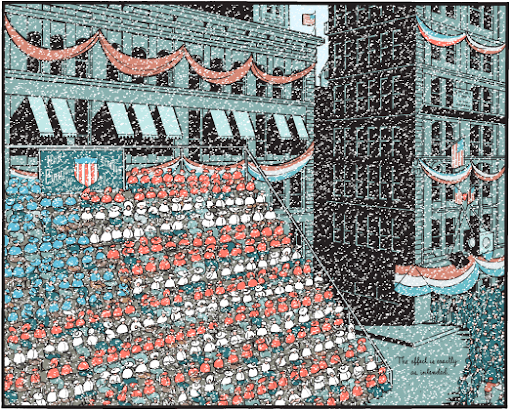
Ware’s writing and illustrations boldly attempt to capture, in his words, “the raw feeling of being alive” and most would say he succeeds. Jimmy Corrigan was the first graphic novel to receive a major UK book award, and Dave Eggers, who has since employed Ware as an illustrator for his acclaimed McSweeney’s publishing house, described it as “arguably the greatest achievement of the form, ever.”
The old cliche is “a picture is worth a thousand words” but Ware viewed that as a challenge, not a presumption.
By marrying his detailed illustrations with nuanced storytelling, Ware took his medium to new heights, making sure it could truly tell his story. He went all in, and in doing so, made art that can stick with its readers for decades.
 Jeff GoodSmith Writes Here